
Gold for All
A Legacy of Inclusion, a Future of Tokenized Prosperity

Gold has played a pivotal role in human society for millennia, evolving alongside societal and economic changes. From its origins as a symbol of divine power to its role as a cornerstone of global finance, gold has continually adapted to meet the needs of each era.
Today, gold is entering its next chapter: tokenization. By bringing gold’s intrinsic value onto the blockchain, this innovation removes barriers to access, making investment-grade gold more inclusive than ever. Matrixdock, a forward-thinking RWA technology provider, is taking this even further by integrating gold into decentralized finance (DeFi). With tokenized gold serving as high-quality collateral for lending, it can now generate yield —unlocking new capital efficiencies. This capability marks a meaningful step toward greater asset inclusivity and financial autonomy.
To appreciate the significance of this transformation, let’s look back at gold’s remarkable journey of finding its way into the hands of a growing and diverse global population.
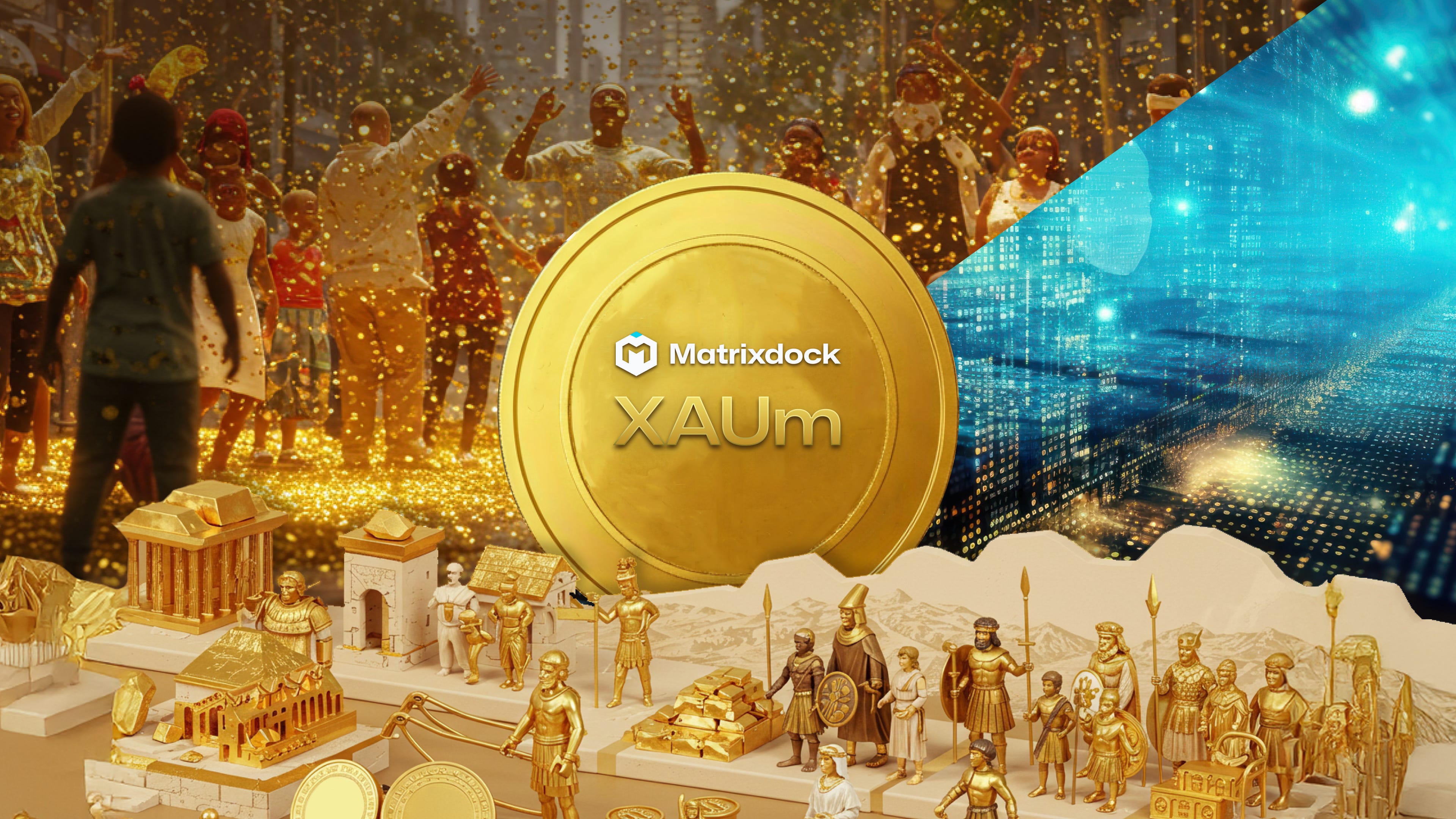
Ancient Beginnings: A Symbol of Power and Divinity
Gold’s allure dates back to 4000 BCE, when ancient Mesopotamian and Egyptian civilizations revered it as a symbol of divine power and immortality. During this era, gold ownership was reserved for royalty and elites, reflecting its status as a representation of authority and spiritual connection.
Gold as Currency: The Birth of Monetary Systems
The transformation of gold from a sacred object to a medium of exchange marked a pivotal moment in history. Around 600 BCE, the Lydians of Anatolia minted the first gold coins, establishing gold as a universal standard of value. In imperial China, gold ingots known as “yuan bao” were used for centuries as a medium of exchange. From 1882 to 1933, gold certificates served as paper currency in the United States and were freely convertible into gold coins.
The Gold Standard Era: Individual Gold Ownership vs. Central Bank Reserves
The 19th century saw the rise and fall of the gold standard, a monetary system in which a country’s currency was directly tied to its gold reserves. Once the foundation of the international monetary system, the gold standard provided stability but struggled to withstand the economic pressures of the World Wars and the Great Depression. To preserve the system, the U.S. introduced the Gold Reserve Act. Between 1934 and 1974, it was illegal for Americans to own gold, except for jewelry and collectible coins. Despite these measures, the fixed gold price remained unsustainable. 1971 President Nixon officially ended the U.S. dollar’s peg to gold, marking the transition to a fiat currency system. Yet, as of 2024, global central banks collectively hold approximately 17% of all gold.
Gold in the Modern Era: ETFs and the Rise of Accessible Investment
In the post-gold standard era, gold remained as trusted hedge against inflation in the long term, currency devaluation, and geopolitical uncertainty. The introduction of gold ETFs (Exchange-Traded Funds) in 2003 made it easier for individuals to gain exposure to gold without owning physical bullion. Initially popular in North America, gold ETFs expanded to Europe and Asia. As of 2024, ETFs collectively held about 1.6% of all the gold that had been mined.
Despite their progress, gold ETFs still have limitations. They remain inaccessible to individuals in regions with underdeveloped financial infrastructure. This gap highlights the need for a more inclusive and innovative approach to gold ownership.
Tokenized Gold: Ushering in a Renaissance for Gold
Tokenized gold is not only a new way to hold gold but also a key to unlocking the ecosystem of "real-world + on-chain finance." As a trailblazer in the tokenization of RWA, Matrixdock has delved deeply into the practicality of gold tokens and proposed two objectives:
Objective 1: Empowering Greater Accessibility and Equality through RWA Technology
For hundreds of millions of individuals in developing regions, verifying the authenticity of gold and accessing credible investment options remains a significant challenge. Many resort to purchasing gold jewelry (representing approx 45% of gold ever mined), which often carries high premiums that diminish resale value, undermining gold’s role as an effective store of wealth. Tokenization democratizes access to high-quality, standardized gold, enabling ownership through Web3 wallets and eliminating geographic and cost barriers.
For example, Matrixdock addresses these issues by minting tokens backed exclusively by LBMA-accredited gold of 99.99% purity. These physical reserves are securely stored in trusted vaults in Hong Kong and Singapore, with regular third-party audits ensuring their integrity. Blockchain technology further enhances transparency by providing verifiable proof of reserves. Each token represents one troy ounce of 99.99% pure gold, and its backing can be independently verified on the blockchain. Qualified investors can hold gold tokens in their Web3 wallets and redeem them for physical gold in Asia in a compliant manner. Learn more about XAUm here.
Objective 2: Gold as a Yield Engine on Blockchain
Tokenized gold goes beyond broadening access—it unlocks entirely new financial autonomy. Unlike traditional gold investments, which offer limited yield-generating opportunities, tokenized gold, such as Matrixdock’s gold token XAUm, integrates with DeFi. For the first time, individuals can leverage their gold as high-quality collateral to borrow stablecoins or cryptocurrencies like Bitcoin or lend their gold to earn interest transparently and efficiently.
Conclusion:
By bringing physical gold onto blockchains, a dynamic digital asset ecosystem emerges, enhancing liquidity, unlocking new cash flow opportunities, and empowering gold investors with greater portfolio diversification and control over their assets. This evolution ensures that gold remains a cornerstone of wealth, with the same value but greater potential for more people.